Posts

England & Wales Autumn Covid deaths show regional heterogeneity. London, in particular, is interesting

Image
England & Wales Autumn Covid deaths show regional heterogeneity. London, in particular, is interesting [27Nov2020_1] London's more severe & earlier spring growth may well explain why it has, to date, seen less of an autumn rise. [Charts normalised by year to date non-Covid deaths.] The generally held belief is that only a small percentage of people have so far been infected by SARS-CoV-2 & that the vast majority remain susceptible to infection - hence all the measures taken. There are, however, reasons & evidence suggesting that this is not the case. If the vast majority of people were still susceptible, one would expect growth everywhere. However, autumn rises have varied greatly across regions. London especially, given its nature (crowding etc) would be expected to show aggressive growth, as it did in spring.  It has not. The past provides a clue as to the reason. London's spring rise in Covid deaths was the most aggressive: not only faster & larger than o...

The Tyranny of Keeping R Below 1

  THE TYRANNY OF "KEEPING R BELOW 1" UK PM and Health Secretary have commented that the goal is to bring R below 1 & keep it there until a vaccine. A Sisyphean task. Impossible. Not due to the virus, but due to a misunderstanding of logic, science & maths. Infections rising: R > 1 Infections falling: R < 1 This would seem simple. As the epidemic grows R is above 1. As it wanes, R is below 1. But infections cannot fall forever. When the level of infections has fallen to very low levels (or even zero) & a large proportion of the infections detected are false positives, then the infection figures will appear fairly stable; albeit with some noise, which is a problem at lower numbers. Since infections are stable, even if this is because they are mostly gone, R cannot remain below 1. R will therefore rise from below 1 to 1. & there it will remain, with some movement due to noise. Indefinitely. To demand that R remains below 1 is to make success impossible. [an...

In the pandemic, what are the most important questions of all?

  In the pandemic, what are the most important questions of all? The PCR debacle, operation Moonshot, masks, school closures, ruined health, futures and incomes, liberties... All spring forth from our underlying beliefs about the virus. These issues, important as they are, distract our attention from the most important questions of all… No one denies that it's a nasty virus that can be lethal. I know people who've suffered with it. I also know plenty who've had horrible experiences with other things too (often caused by the avoidable actions of people). There's no risk-free option. It was claimed approx 500K people in the UK & 2M in USA would die, (~0.5-1% of the population). On that basis we closed much of the world. But, even the hardest hit countries lost roughly one tenth of that number of people (& that despite the differences in measures taken). You can - you should - look those numbers up for yourself. It looks like we overestimated the problem by somethi...

Czech Republic & other European Higher Fatality Countries

Image
CZECH REPUBLIC & OTHER EUROPEAN HIGHER FATALITY COUNTRIES Signs of Czech Rep deaths slowing? I wish them well. Interesting, yet again, that the cumulative total is so similar to other hard hit locations, which are all around 10x lower than generally used predictions... The point is not to use these data for some ugly competition. Rather, these data and their differences - or similarities - can reveal very important information about #SARSCoV2 . For example, UK deaths were predicted to reach ~7500 per Million (=~500k people, without measures). However, if the hypotheses that led to such predictions were true, & such totals have only been averted by lockdown, then one would expect large variations between countries (as exact details & timing of lockdown and other measures would be critical). High sensitivity to timing would be the case if "high lethality+all susceptible+lockdowns work" hypotheses were true. Yet all the high fatality locations have quite similar tota...

Recent UK rises have been regional

Image
Recent UK rises have been regional England & Wales normalised regional Covid deaths, w/e 6Mar20 - 30Oct2020 The North West (front/left ribbon) shows the highest normalised increase, while London, more severely affected in spring (tallest peak), appears far less affected now. @RuminatorDan

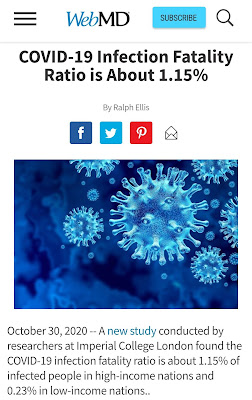
COVID-19 Infection Fatality Ratio is About 1.15%, new ICL study

Image
 "COVID-19 Infection Fatality Ratio is About 1.15%" - new ICL study Higher than 0.7% IFR in ICL's Oct '20 'fading antibodies' study. Higher than 0.9% UK IFR in the March report predicting ~500k deaths, used to justify lockdowns. Interpret with care... https://www.webmd.com/lung/news/20201030/covid-19-infection-fatality-ratio-is-about-one-point-15-percent IFR - its value & even its definition - is an issue open to some debate. Suggested values vary and comorbidities confuse matters. The WHO, for example, recently implied an IFR of ~0.13%; similar to the sort of value found by John Ioannidis. What actually matters though is not just the probability of succumbing to the virus if infected but also the probability of becoming infected in the first place. Population Fatality Rate (PFR) = probability of infection X IFR ...is a very useful concept for this. We have been modelling & making policy under the assumption that 100% of the population are susceptible ...

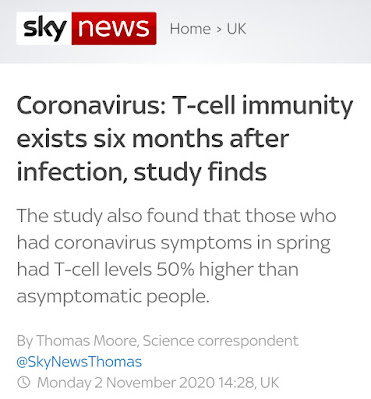
Coronavirus: T-cell immunity exists six months after infection, study finds

Image
"Coronavirus: T-cell immunity exists six months after infection, study finds" - Sky https://news.sky.com/story/amp/coronavirus-t-cell-immunity-exists-six-months-after-infection-study-finds-12121816 This must come as quite a shock. Who'd have thought there could be more to immunity than antibody levels? Of course that's not the whole article... The article goes on to say... "But the researchers, from Public Health England and the UK Coronavirus Immunity Consortium, warn that it's still not clear whether the T-cell levels were high enough to protect against re-infection." I suggest referring to known science as a starting point.  There used to be quite a lot of it around, although we seem to have mislaid it recently. To be cautious though I suggest (seriously) this: 1) Treat as true the commonly declared hypothesis that "only people with measurable levels of antibodies have immunity". 2) Work out what should happen if that is the case. 3) Test yo...